

Vitamin D2 and vitamin D3 are two forms of the same nutrient. You will see both on supplement labels and in some fortified foods, but they are not sourced in exactly the same way. If you are comparing products in the UK, the useful questions are simple: which form is listed, where does it come from, how much is in the full daily serving, and does the whole formula suit your dietary requirements?
This guide explains the difference without turning it into a contest or suggesting that a higher-strength supplement is automatically a better choice.
The short answer: D2 and D3 are different forms of vitamin D
- Vitamin D2 is called ergocalciferol. It is commonly produced from fungi or yeast exposed to ultraviolet light.
- Vitamin D3 is called cholecalciferol. Human skin produces D3 after exposure to UVB sunlight. Supplement D3 is commonly sourced from lanolin, but non-animal D3 made using lichen is also available.
- Both forms contribute to vitamin D intake. Research has compared how they affect the blood marker 25-hydroxyvitamin D, often written as 25(OH)D, but study results do not mean one form or dose is right for every person.
Vitamin D2 vs D3 at a glance
| What to compare | Vitamin D2 | Vitamin D3 |
|---|---|---|
| Scientific name | Ergocalciferol | Cholecalciferol |
| Common supplement source | Fungi or yeast, often using UV exposure during production | Often lanolin; some products use lichen-derived D3 |
| Can it be vegan? | Often, but check the full formula and capsule | Yes, when the D3 source and all other ingredients are non-animal |
| Can it appear in food? | Used in some fortified foods | Found naturally in some animal foods and used in some fortified foods |
| What should you check? | Amount per daily serving and the complete ingredient list | Amount per daily serving, source of D3 and the complete ingredient list |
The front of a bottle may say “vitamin D” without making the form obvious. Check the ingredients or nutrition panel for “ergocalciferol” (D2) or “cholecalciferol” (D3). If the source matters to you, look for an explicit source statement rather than assuming every D3 product is vegan or every D2 product is automatically suitable for every diet.
What does research say about D2 and D3?
Researchers have compared D2 and D3 by measuring changes in blood levels of 25-hydroxyvitamin D. This is a marker used when assessing vitamin D status. It is important to distinguish a change in a blood marker from a proven difference in health outcomes for every individual.
A 2012 systematic review and meta-analysis in the American Journal of Clinical Nutrition found an overall advantage for D3 in raising 25(OH)D. However, when the authors separated daily supplementation from larger, less frequent doses, the difference was not statistically significant in the daily-dose subgroup. The authors also noted that more research was needed across different groups of people.
A later systematic review and meta-analysis, published in Advances in Nutrition in 2024, assessed 20 comparisons. It found that D3 raised total 25(OH)D more than D2 overall, including in daily-dose studies. The authors also reported substantial variation between studies and identified factors such as body mass index and starting vitamin D status as possible influences on the response.
These reviews help explain why D3 is common in supplements, but they are not a reason to self-prescribe a high dose. They compare changes in a laboratory marker; they do not establish that everyone needs D3, that D2 is unsuitable, or that taking more vitamin D produces a better result. If a clinician has recommended a particular form or dose, follow that advice rather than switching based on a general comparison.
Sources: Tripkovic et al. (2012), systematic review and meta-analysis and van den Heuvel et al. (2024), systematic review and meta-analysis.
Is vitamin D3 vegan?
It depends on where the D3 comes from. A common commercial source is lanolin, the wax found in sheep’s wool. D3 made from lanolin is not vegan. Some manufacturers instead use lichen as a non-animal source of cholecalciferol. The ingredient is still vitamin D3; the source is different.
Vitamin D2 is often made using fungi or yeast, so it is commonly suitable for vegan products. But the vitamin itself is only one part of the check. A capsule may contain gelatin, and a formula may include animal-derived carriers or other ingredients. Look at the full ingredient list and, if the source is not clear, ask the manufacturer or retailer.
For a vegan D3 product, check all of the following:
- The D3 source is stated as lichen or another confirmed non-animal source.
- The capsule shell is plant-based rather than gelatin.
- Any carrier oil, coating, flavouring and processing aids are suitable for the dietary standard being claimed.
- Any vegan certification or logo is genuine and applies to the finished product, not just one ingredient.
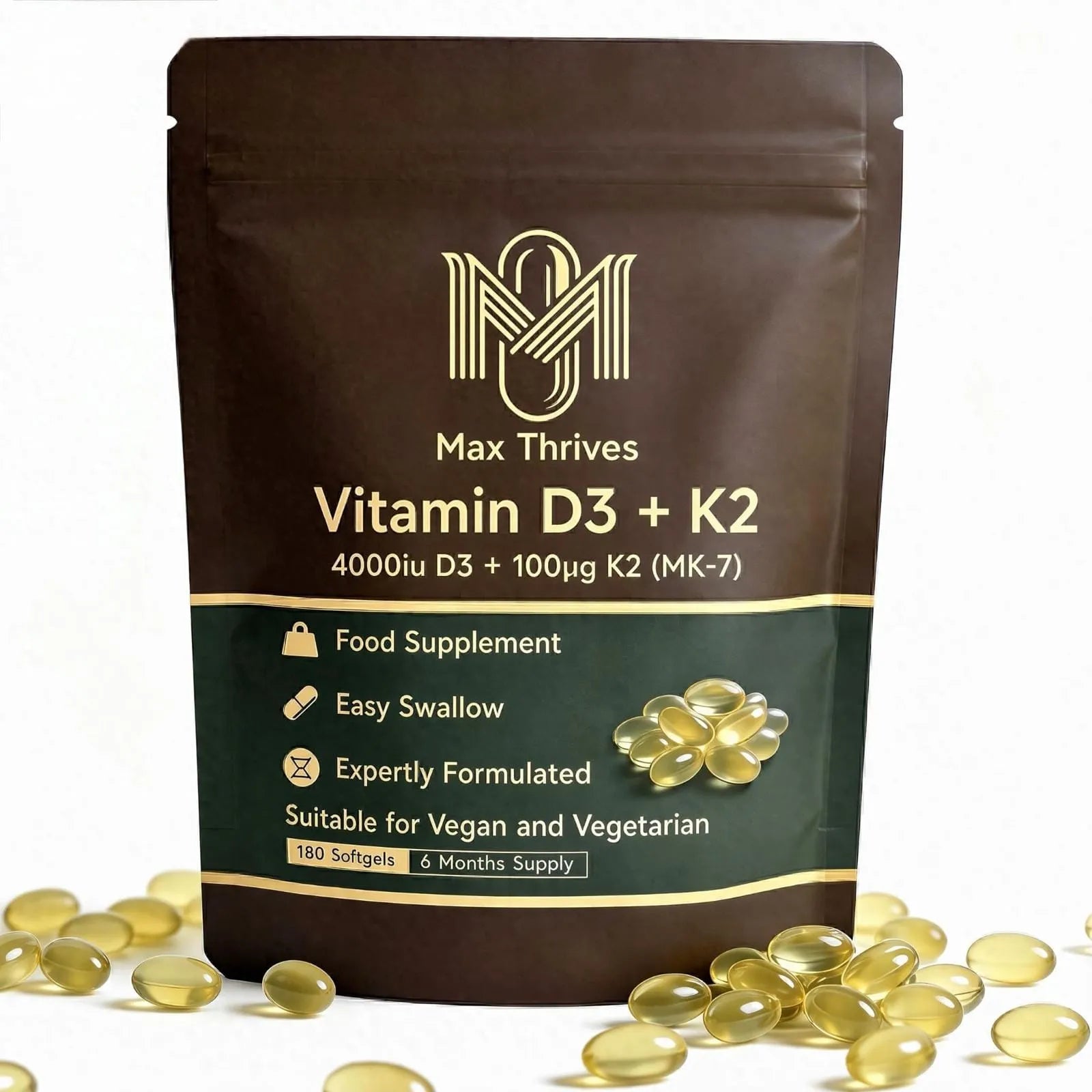
For transparency, the Max Thrives Vegan Vitamin D3 + K2 product page lists D3 from lichen, K2 MK-7 from fermentation, an olive oil base and a vegan softgel shell made with pullulan and modified tapioca starch. Those are the product details shown on the current listing; always read the live label and product information before purchase.
How much vitamin D do adults in the UK need?
The NHS says adults and children aged one year and over need 10 micrograms (µg) of vitamin D a day. For most people, it advises considering a daily supplement containing 10 µg during autumn and winter. Some groups are advised to consider a 10 µg supplement throughout the year, including people who have little or no sun exposure and people with darker skin. The advice for babies and young children is age-specific.
Vitamin D labels may show micrograms (µg), international units (IU), or both. For vitamin D:
- 1 µg = 40 IU
- 10 µg = 400 IU
- 25 µg = 1,000 IU
- 100 µg = 4,000 IU
The NHS advises adults not to take more than 100 µg (4,000 IU) of vitamin D a day because too much over time can be harmful. That upper limit is not a target or a routine recommendation. The NHS says 10 µg a day is enough for most people. Some medical conditions and medicines can change what is suitable, so speak to a GP or pharmacist if you are unsure, already use another vitamin D product, or have been prescribed a different amount.
Our D3 + K2 softgel lists 100 µg (4,000 IU) of vitamin D3 per softgel. That is a high-strength amount, not the standard UK public-health recommendation. Do not treat the upper limit as a target or combine multiple vitamin D supplements without checking your total intake and seeking professional advice where appropriate. See the NHS vitamin D guidance for current advice.
How to compare a vitamin D supplement label
- Check the form. Look for D2 (ergocalciferol) or D3 (cholecalciferol), not just the words “vitamin D”.
- Read the amount per daily serving. A front label may show the amount per capsule, while the directions may say to take more than one. Compare the full stated daily portion.
- Convert µg and IU correctly. For vitamin D, multiply micrograms by 40 to get IU. Do not confuse milligrams (mg) with micrograms (µg).
- Check the source if it matters to you. D3 can be animal-derived or lichen-derived. Do not assume the source from the D3 name alone.
- Read the whole ingredient list. Capsule shells, oils and other ingredients can affect whether a product meets your dietary requirements.
- Check warnings and avoid doubling up. Look at other supplements and fortified products you use. Follow the label and ask a healthcare professional if you take medicines or have a medical condition.
If you want to understand why some vitamin D softgels use an oil base, read our guide to vitamin D and supplement formats. For food sources and seasonal UK guidance, see Vitamin D Foods in the UK: Winter Advice & Supplement Labels.
Does vitamin D3 need to be combined with K2?
D2 versus D3 is a comparison between two forms of vitamin D. It does not answer whether a person needs a separate vitamin K supplement. Vitamin K is a different nutrient, and a combined D3 + K2 product is one formulation choice rather than a universal requirement. If you want to understand what the two nutrients contribute and what to check on a combined label, read our separate guide: Vitamin D3 and K2 Together: What to Know.
Frequently asked questions
Is vitamin D3 better than D2?
Some systematic reviews have found that D3 raises total 25(OH)D more than D2 on average, but the size of the difference varies with study design, dosing pattern and participant characteristics. This does not mean D2 is unsuitable or that D3 is automatically the right choice for every person.
Is vitamin D2 vegan?
D2 is commonly produced from fungi or yeast and is often used in vegan products. Check the complete ingredient list, including the capsule and any carrier ingredients, before relying on a vegan claim.
Can vitamin D3 be vegan?
Yes. D3 made from lichen is a non-animal source. D3 made from lanolin is animal-derived. The finished product also needs a suitable capsule shell and other ingredients.
Is 4,000 IU of vitamin D the normal daily amount?
No. 4,000 IU is 100 µg. The NHS says 10 µg a day is enough for most people and advises adults not to take more than 100 µg a day. The upper limit is not a target. Follow professional advice if you have been prescribed a different amount.
Can I switch from prescribed D2 to an over-the-counter D3 supplement?
Do not change a prescribed vitamin D preparation or dose without speaking to the prescriber or pharmacist. Prescribed treatment can have a different purpose and schedule from a general food supplement.
Where can I read more about vitamin D in the UK?
Start with the NHS vitamin D page. You can also read our guides to vitamin D food sources, fat-soluble vitamin D formats and D3 and K2 together.
More than supplements
A good supplement decision starts with the label, the evidence and the context of your own routine. D2 and D3 are both forms of vitamin D; source, serving size, dietary suitability and dose all matter. A supplement should complement a varied, balanced diet and a healthy lifestyle, not replace them. When the right form or amount is not clear, a pharmacist or GP is the right person to ask.
Editorial note: This article is general educational information for UK readers, not individual medical advice. Always follow the product label and any advice from your healthcare professional.